
Direct answer
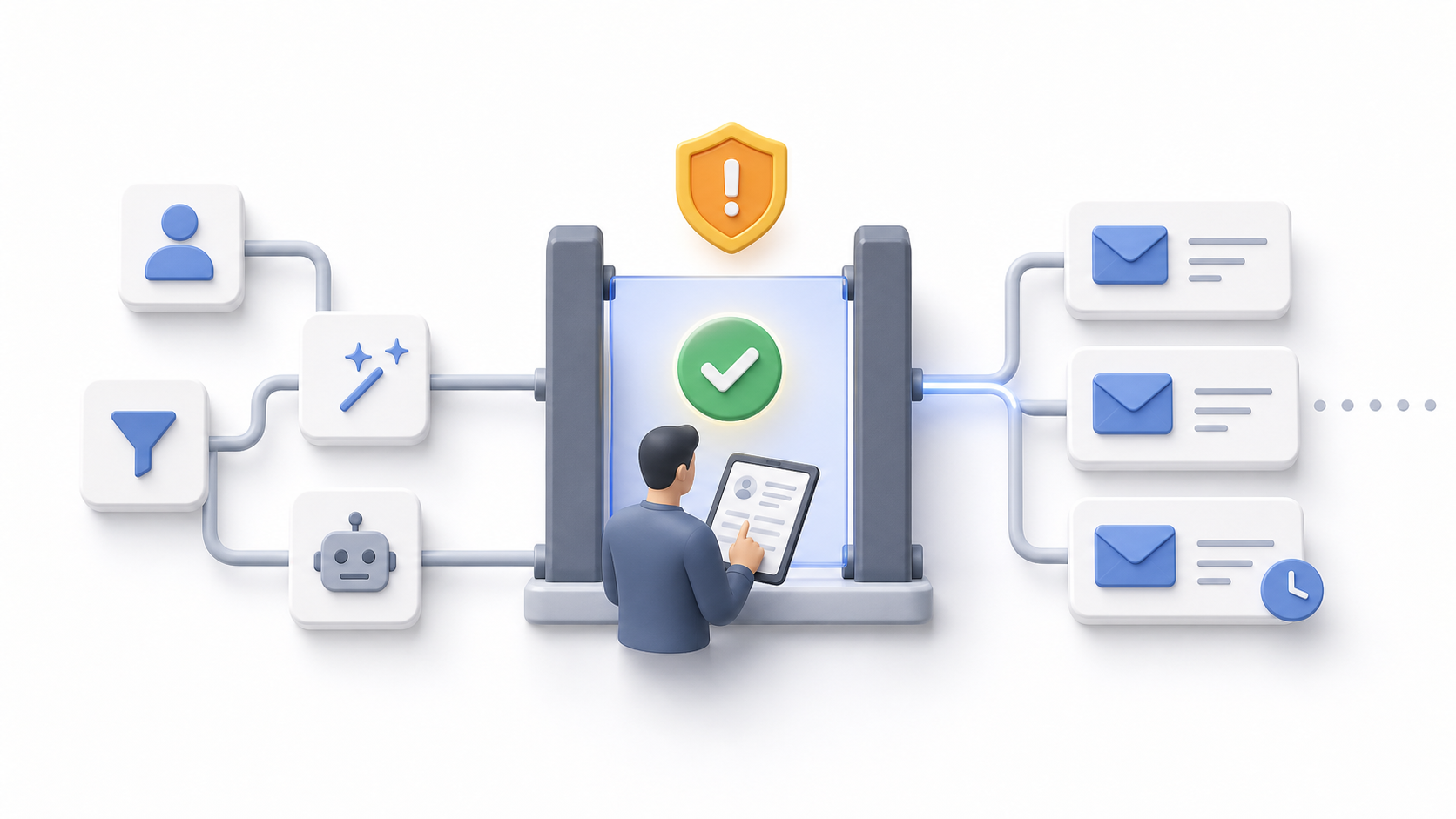
Review-first automation lets software prepare research, drafts, and next actions while a human approves risky or context-sensitive steps. It is safer than full auto-send because outreach quality, compliance, timing, and reputation often require judgment.
The core industry problem: speed often outruns judgment
Automation promises scale. It can search faster, enrich faster, generate drafts faster, and schedule messages faster than a human team. The danger is that outreach is not only an operational task. It is a social, legal, and reputational action.
When full auto-send is applied too early, mistakes move at machine speed. A bad match becomes a bad message. A stale email becomes a bounce. A weak personalization token becomes an embarrassing note. A contact who should have been suppressed receives another message.
The industry has learned this lesson repeatedly. Teams buy automation to reduce manual work, but then discover that unreviewed automation can create customer complaints, platform restrictions, domain reputation problems, and brand damage.
What review-first automation means
Review-first automation does not mean doing everything manually. It means allowing the system to prepare work while keeping approval gates where the risk is high. The system may gather data, classify records, draft messages, and recommend actions. A person then approves, edits, skips, or sends.
This model is especially useful when targeting is still being tested, data confidence varies, the message is sensitive, or the recipient relationship is unclear. It gives teams the benefits of automation while preserving accountability.
The best review-first systems make review efficient. They show the evidence, the reason for the recommendation, the draft, the risk flags, and the available actions in one place.
Where full auto-send can go wrong
- Sending to the wrong person because the title matched but the responsibility did not.
- Using a stale or low-confidence email address.
- Sending a message that references incorrect company context.
- Ignoring suppression, unsubscribe, bounce, or complaint history.
- Sending too quickly across a channel with strict safety limits.
- Continuing a campaign after early signals show poor relevance.
Full auto-send can work only when inputs, rules, confidence, timing, and message quality are controlled. Many teams skip that foundation and jump directly to volume.
A safer automation maturity model
- Manual process: understand the workflow and risks.
- Assisted automation: automate research and organization.
- Draft automation: generate messages but require approval.
- Guarded sending: allow sends only when confidence and policy checks pass.
- Measured expansion: increase volume only after quality metrics are stable.
This maturity model prevents teams from treating automation as a switch. It becomes a progression from understanding to assistance to controlled execution.
What reviewers should look for
A reviewer should not only check grammar. They should check whether the recipient is correct, the reason for contact is legitimate, the data evidence is strong, the message is specific, and the channel is appropriate.
Review should also include negative checks. Is this person already contacted? Did they unsubscribe? Did a previous email bounce? Is the domain paced correctly? Is the message too generic? Does the campaign still make sense based on early replies?
Metrics that decide when to automate more
Teams should earn more automation with evidence. Useful metrics include approval rate, edit rate, bounce rate, complaint rate, unsubscribe rate, reply quality, meeting quality, and reviewer disagreement.
If reviewers are editing most drafts, the generation rules are not ready. If bounce rates are high, discovery and verification need work. If replies are negative, targeting or message relevance needs attention. Automation should expand only when these signals are healthy.
A real-world operating checklist
Before this kind of workflow is scaled, it should be written down in plain language. The team or individual should know what triggers the workflow, what evidence is required, who reviews uncertain cases, what actions are allowed, and what signals should stop or slow the process.
A practical checklist starts with the audience or object being worked on, then defines the quality bar. In outreach, that means relevance, timing, contact confidence, suppression status, and message fit. In job search, that means role fit, company fit, contact path, application status, and follow-up timing. In recruiting, that means candidate fit, hiring context, consent, and relationship stage.
The checklist should also include ownership. A workflow fails when everybody can see a problem but nobody owns the next action. Assigning ownership does not need to be bureaucratic. It can be as simple as saying the researcher owns missing context, the reviewer owns message approval, and the campaign owner owns pacing and outcomes.
Finally, the checklist should define what good looks like. Good is not more records, more messages, or more activity by default. Good means better-fit opportunities, fewer avoidable mistakes, clearer decisions, and a process that produces useful learning each week.
Questions to answer before scaling
- Do we know exactly who or what this workflow is for?
- Do we have enough evidence to justify the next action?
- What conditions should block, pause, or downgrade the workflow?
- Who reviews uncertain cases, and what information do they need?
- Which metrics prove quality, not just activity?
- What will we do when the workflow produces bad matches or negative signals?
- How often will we review results and improve the rules?
These questions matter because scaling a weak process makes the weakness more expensive. A small manual sample can reveal whether the logic is sound before automation expands the volume. If the first 25 records are noisy, the next 2,500 records will not magically become useful.
The healthiest teams treat automation as an amplifier of a tested workflow. They first make the workflow understandable, then make it repeatable, then make it measurable, and only then make it larger. This order protects quality and keeps the process grounded in real-world judgment.
How to evaluate whether the system is working
A deeper workflow should be judged by decision quality, not only by output volume. Volume is easy to count, but it can hide weak targeting, poor timing, low confidence data, and unclear ownership. A workflow that produces fewer but clearer decisions may be more valuable than a workflow that creates hundreds of records nobody trusts.
The first evaluation layer is relevance. Are the records, people, jobs, posts, or companies actually connected to the intended purpose? If the workflow is producing many edge cases, the targeting logic needs to be narrowed. If reviewers repeatedly reject the same kind of record, that rejection reason should become a rule rather than a repeated manual task.
The second layer is readiness. A record may be relevant but not ready. It may be missing contact evidence, role context, consent status, sender configuration, verification, or campaign fit. Readiness metrics help teams understand whether the process is blocked by sourcing quality, enrichment quality, review capacity, or operational setup.
The third layer is outcome quality. For outreach, useful signals include positive replies, thoughtful objections, meetings, applications, referrals, and qualified conversations. For internal workflows, useful signals include fewer stuck records, faster review, lower rework, and clearer ownership. These measurements are more meaningful than raw sends, raw searches, or raw contacts created.
A strong evaluation habit is to review a small sample of completed and rejected items every week. The sample should include successful outcomes, ignored items, manually edited items, and blocked items. This makes it easier to see where the workflow is helping and where it is creating hidden work.
The review should end with one concrete improvement. That improvement might be a narrower source, a clearer exclusion rule, a better confidence threshold, a rewritten message template, or a new blocked-state action. Small weekly improvements compound faster than occasional large redesigns because they are grounded in evidence from real usage.
How teams usually mature this workflow over time
Most teams do not begin with a perfect process. They start with a rough workflow, learn where judgment is required, and gradually convert repeated judgment into rules. This maturity path is healthy because it prevents the system from becoming over-engineered before the real-world edge cases are known.
In the early stage, the priority is visibility. Users need to see what was found, why it was found, what evidence exists, and what decision is recommended. At this stage, review-first behavior is usually better than automatic execution because the team is still learning what good and bad records look like.
In the middle stage, the priority is consistency. The team begins to standardize naming, stages, scoring, suppression, ownership, and review criteria. Repeated manual decisions become saved filters, required fields, confidence thresholds, or action rules. This is where the workflow starts to feel reliable rather than experimental.
In the advanced stage, the priority is controlled scale. The team can automate more because the rules are clearer, the data is cleaner, and the review process is measurable. Even then, the best systems keep exception handling visible. Edge cases should not disappear; they should be routed to the right person with enough context to make a decision.
The main sign of maturity is not that humans disappear from the workflow. It is that humans spend less time cleaning avoidable mess and more time making the few decisions where judgment genuinely matters.
FAQ
Is review-first automation slower?
It can be slower than full auto-send, but it is often faster than manual work and safer than scaling mistakes.
When is full auto-send appropriate?
It is appropriate only when targeting, data quality, suppression, limits, message rules, and monitoring are mature enough to control risk.
What should be reviewed before sending?
Review recipient fit, data evidence, message relevance, compliance status, suppression history, and channel timing.
How GrowthEngene can help
GrowthEngene can help by preparing research, drafts, safety checks, and action items while keeping review and approval available before sensitive outreach is sent.
The important principle is still the same with or without software: start with a clear workflow, keep human judgment in the loop where risk is high, and measure quality before volume.